Microplastic Toxicity in Biological Systems: Physical Damage, Chemical Pathways, and Health Implications
Nitin Puranik *
Institute of Sciences, SAGE University Indore, KailodKartal, Indore-Dewas By-Pass, Road, Indore, Madhya Pradesh 452020, India.
Sangeeta Ijjatdar
PG Department of Zoology, Government (Model Autonomous) Holkar Science College, Indore, Madhya Pradesh, 452001, India.
Pramila Kori
PG Department of Chemistry, Government (Model Autonomous) Holkar Science College, Indore, Madhya Pradesh, 452001, India.
Santosh Gaherwal
PG Department of Zoology, Government (Model Autonomous) Holkar Science College, Indore, Madhya Pradesh, 452001, India.
Sandeep Kumar Verma
Institute of Sciences, SAGE University Indore, KailodKartal, Indore-Dewas By-Pass, Road, Indore, Madhya Pradesh 452020, India.
*Author to whom correspondence should be addressed.
Abstract
Microplastics (MPs) are considered to be dominant agents responsible for serious contamination in environmental and biological systems. Despite a huge increase in research on these contaminants, there are still considerable uncertainties and progress to be made on the exposure pathways of biological systems, modes of detection, and toxicity assessments. The ubiquitous presence of microplastics across diverse environmental matrices has emerged as a major ecological concern due to their potential for bioaccumulation and biomagnification within trophic networks. Defined as synthetic plastic polymer particles smaller than 5 mm, MPs are now widely detected in marine, freshwater, terrestrial, and atmospheric systems, where they exert both physical and chemical impacts on organisms. Physically, MPs induce adverse effects through ingestion, entanglement, and obstruction, often causing external abrasions, gastrointestinal blockages, inflammation, and internal organ swelling. These effects are particularly pronounced in aquatic fauna, including invertebrates and vertebrates, as well as in avian species and some marine mammals, which may mistake MPs for food due to their size, color, or texture. Chemically, MPs composed of polymers such as polypropylene, polyethylene, and polystyrene can interfere with physiological processes, while also serving as vectors for residual monomers, plastic additives (e.g., plasticizers, stabilizers), and adsorbed persistent organic pollutants. Once internalized, these substances can disrupt endocrine signalling, impair immune responses, induce reproductive dysfunctions, and cause systemic organ damage, ultimately compromising the health and survival of exposed organisms. This study provides a comprehensive evaluation of the mechanisms by which MPs exert toxicity, examining both their physical structures and chemical constituents, and synthesizes current evidence on organismal responses to microplastic exposure, with the aim of elucidating pathways of toxicity and highlighting broader implications for ecosystem integrity and human health. Addressing microplastic pollution requires coordinated international action, interdisciplinary research, and precautionary policy frameworks to safeguard ecosystems, food security, and human health.
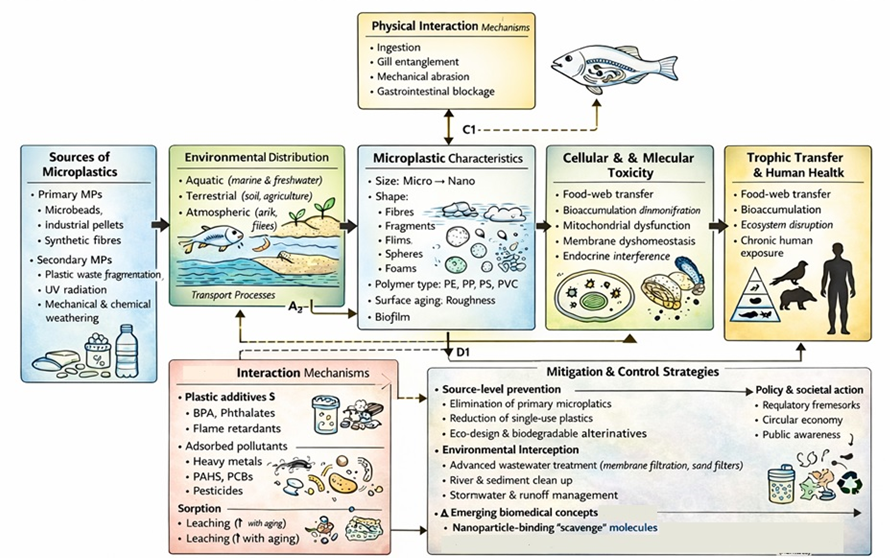
Fig. 1. Graphical abstract image of physical damage, chemical pathways, and health implications of microplastics in environment
Keywords: Microplastics, physical damage, toxic chemicals, toxicity mechanisms, trophic transfer